It’s time for Direct Vision for Dublin
Dublin Cycling Campaign strongly endorses the motion put recently to the City Council by Councillor Ray Cunningham, calling for safer trucks.
On April 13th, Councillor Cunningham called for Dublin to urgently adopt the Transport for London Direct Vision Standard for heavy goods vehicles.
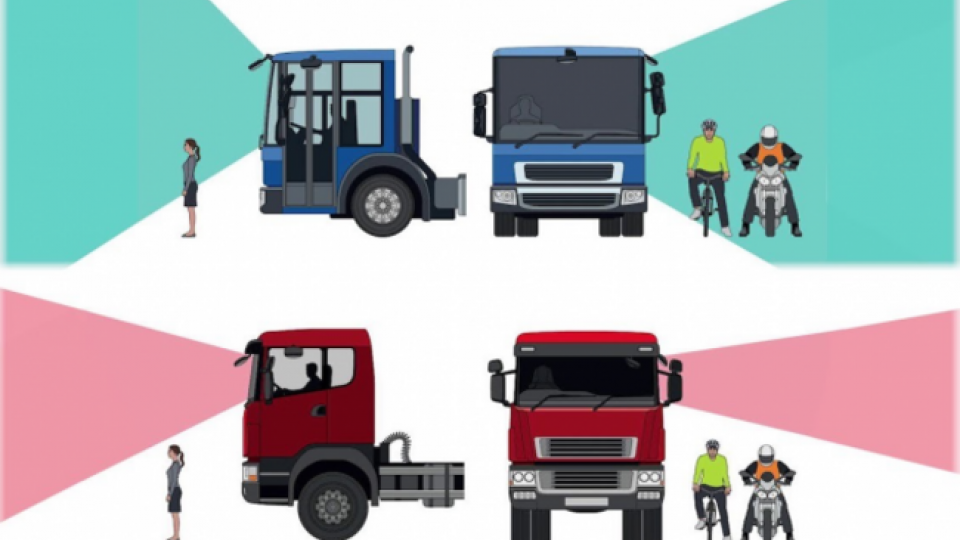
What’s the issue? Huge blind zones exist for the drivers of many HGVs in Ireland: Designed for long-distance, heavy hauling, such trucks have high-windowed cabs with the driver seated well above the ground, well back from the windows. Unless special mirrors or cameras are fitted, their vision is partially blocked to the rear, side and front. The above illustration by Transport for London shows, in the upper diagram, a truck with direct vision: The large green zones show what the driver can see. Ireland still has a prevalence of HGVs like the lower diagram: The driver is unaware of any of the vulnerable road users surrounding the vehicle.
That means that cyclists, pedestrians - even small cars - can be in their path and the driver won’t be aware. It’s a feature that continues to cause tragic outcomes: HGVs are massively over-represented in the death toll on Irish roads, compared to their share of vehicle numbers overall. Sadly the toll of Dubliners is long, most recently being joined by Johnny Santos and Josilaine Ribeiros, both reportedly killed by left-turning truck drivers who failed to see them.
What’s the solution? It’s well established, just across the Irish Sea. Transport for London have been working methodically for many years to increase the safety levels of HGVs on their road network. Since March 2021 vehicles have been required to have a rating of at least one star under TfL’s Direct Vision Standard. For one star a driver needs to be able to see an average person’s head and shoulders from within 4.5m at the side, and 2m in front. From October 2024, all HGVs over 12 tonnes entering London must have either a three-star rating, or fit a defined set of vehicle safety measures. The results? Serious injuries involving HGVs more than halved between 2017 and 2021 - from 48 to 17.
EU rules for safer trucks aren’t to come into force until 2029, although the EU’s NCAP ratings have been revised to include a ‘CitySafe’ label for compliant models of truck. A requirement for trucks entering Dublin streets to be models that have earned this label might offer a potential alternative - or temporary - approach to Direct Vision. But we’re convinced the graduated and specific Direct Vision Standard sets a workable, fair precedent. Adopting it in Ireland would allow fleet managers to benefit from established practice in our neighbours, and from the right-hand drive vehicle market deriving from the London requirements.
We call for–
- Direct vision trucks only for major projects-
- Metrolink
- Finglas Luas
- BusConnects
- Dart Plus;
- CLOCS standards for all major State contracts;
- 24/7 enforcement by camera and automated fining of unsafe operators;
- A national programme: It’s not just in Dublin these vehicles pose risks;
- At the very least, major State contracts must require NCAP CitySafe label;
- Haulage companies need time to plan their future purchases and re-sale of older vehicles, so the process needs to be started soon;
Shockingly the RSA deleted mention of Direct Vision from its national Road Safety Strategy during its last revision. It was High Impact Action 11 in the RSA’s Safety Strategy Action Plan 2021-24, but in the current Plan, it’s not mentioned. Either our national authorities introduce safe standards, or a group of cities could join forces to implement Dublin-style safety requirements within the urban cordon.
When trucking industry spokespersons were asked about this in recent press or radio stories, they merely deflected blame onto cyclists and called for more hi-visibility clothing. One went so far as to scoff on national radio at the potential safety measures, saying they wouldn’t be enforced. So the City needs to create a robust and effective regime. This can be done: We know that registration plate-reading cameras can be part of enforcement systems, and automation is becoming more and more effective. Foot-dragging and buck-passing regarding speeding and enforcement cameras has gone on too long.
We’re heartened that the Council moved to further discuss the matter at the Mobility and Public Realm Strategic Policy Committee. We urge the SPC Chair to push for concrete action. Dublin does have the power to protect our vulnerable road users. The families of Johnny Santos, Josilaine Ribeiros and far too many others deserve it.
This post is published also on the website of the Irish Cycling Campaign
Help us do more for cycling in Dublin by becoming a member!